Jerusalem’s Lot’s vampiric occupation
'Salem's Lot: A NovelJerusalem’s Lot’s vampiric occupation is the condition in which the town becomes a vampire-controlled community while continuing, for a time, to resemble an ordinary place. Its decisive horror lies in that contradiction: the town is dead without immediately appearing dead, and its familiar geography—roads, houses, farms, bridges, workplaces, and shops—becomes the infrastructure through which the undead spread. The occupation therefore turns a small-town social order into a hidden ecology of infection, concealment, and nocturnal violence.
A Town Built for Concealment
Jerusalem’s Lot is nearly circular, with Brock Street crossing Jointner Avenue at right angles through the center, giving the settlement the appearance of a telescopic sight on a map. The arrangement divides the town into recognizable social and physical zones. North Jerusalem is wooded high ground, threaded with old logging roads, with Marsten House standing on the last hill before the land slopes toward town. The northeast contains open hay and alfalfa fields, the Royal River, the Brock Street Bridge, and the cliffs known as Drunk’s Leap. The southeast is the most attractive agricultural district, dominated by farms and the view from Schoolyard Hill; the southwest, by contrast, contains the Bend, where trailers, junked cars, improvised yards, children, pickup trucks, and neglected septic systems mark a poorer and more precarious margin. The occupation gains force from this existing division of space. The town is not an undifferentiated backdrop: wooded high ground, agricultural outskirts, roads, bridges, cemeteries, homes, and commercial edges offer different degrees of visibility, isolation, mobility, and vulnerability. The Bend’s roads lead toward Dell’s, a bar rebuilt after a 1971 fire and known for beer, fights, and weekend bands, while the more settled parts of town remain threaded by party telephone lines and constant gossip. The same close surveillance that ordinarily produces scandal becomes an inadequate defense against a threat that moves through private rooms, family ties, and the night.
From Ordinary Life to Hidden Death
Before the occupation, Jerusalem’s Lot has a strong habit of minimizing danger. National wars, political crises, and even local deaths are treated as distant or exceptional intrusions into an apparently protected routine. The town receives much of its knowledge of national suffering from television, while local violence—such as fatal drunken driving on Deep Cut Road—can be absorbed as an isolated misfortune. The governing assumption is that nothing truly terrible happens in such a nice little town. This collective confidence makes the community vulnerable: ordinary explanations and ordinary schedules continue operating after the supernatural reality has already taken control. The town’s economic life also contains a darker pattern of acquisition and dependency. Larry Crockett’s trailer business grows from a close reading of Jerusalem’s Lot zoning laws, speculative land purchases, heavy borrowing, and financing that makes supposedly affordable homes available to people unable to afford conventional houses. His trailers offer one-level living to lower-middle-class workers and older people stretching social security, but the apparent accessibility rests on steep interest and debt. By the time R.T. Straker enters his office, Larry is worth nearly two million dollars, accumulated through land speculation and mobile-home businesses. This history of property, profit, and people being drawn into systems they do not fully understand forms a human analogue to the later occupation: the town is already organized by hidden obligations before vampirism makes those obligations literal and bodily. The arrival of R.T. Straker and Kurt Barlow converts that latent structure into an openly predatory one. Straker’s business presence and the reoccupation of Marsten House place the supernatural threat inside recognizable commercial and domestic forms. A house can be bought, furnished, opened, and occupied; a town can continue to conduct business; a family can remain in its rooms. Yet beneath those appearances, the community is being reorganized around the needs of a vampire master and the servants, victims, and newly converted dependents attached to him.
The Occupation Becomes Visible Through Absence
The occupation advances through disappearances, deaths, returns, and changes that the town repeatedly fails to interpret. Danny Glick’s burial on September 28 marks the first day of real fall, and the open graveside service draws classmates, relatives, curious residents, and older mourners from across the community. The public funeral gives the town a shared ritual of grief, but it also places death at the center of its seasonal and civic life. What appears to be a single family tragedy becomes part of a wider process in which the dead no longer remain safely separated from the living. By the morning of October 6, no one has formally declared Jerusalem’s Lot dead, and no one knows that it is. The bodies of the previous days still retain every semblance of life, while Ruthie Crockett has disappeared and her mother lies hidden behind cellar shelves beneath a canvas tarpaulin. Larry Crockett, weakened, light-sensitive, nauseated, and unable to recognize the significance of his own condition, treats the morning as illness rather than transformation. His household demonstrates the occupation’s method: a family can be destroyed without an alarm being raised because the remaining members continue to interpret the evidence through ordinary habits. The spread is not confined to one household. Danny Glick finds and feeds upon Jack Griffen, after which Jack goes to his brother Hal’s room; both boys end up hidden in the upper mow of a hayloft. Their bodies lie amid loose hay, chaff, pollen, and mice while daylight covers the land. The contrast is central to the occupation’s operation: evil acts during the night, then sleeps when the sun arrives, leaving the town to resume work without understanding what has happened. The days shorten toward Halloween and winter, so the seasonal movement itself seems to assist the vampires by granting darkness an increasing share of the day. The occupation also creates a strange form of enforced isolation. In one silent interior, Mark Petrie and Susan Norton know they are not alone even though the house offers no obvious sign of another presence. Elsewhere, residents who remain awake turn on every light and search drawers, attics, and bedroom collections for religious symbols without fully knowing why. They move through their homes slowly and avoid looking out the windows. Their instinctive gestures reveal both resistance and helplessness: religious objects survive as fragments of defense, but knowledge of the enemy has not yet become collective understanding.
Nocturnal Sovereignty and Social Collapse
The vampires’ rule is governed by time. When the horizon has narrowed to a bitter orange line and the stars have emerged, the narrative announces that the vampire’s time has come. Bedtime, cribs, frightened children, and parents checking closets remain part of ordinary domestic ritual, but the night surrounding those rituals belongs to the undead. The occupation thus colonizes the very hour associated with sleep, trust, and dependence. Houses that should protect children become points of entry, and family intimacy becomes a route by which vampirism passes from one person to another. The town’s collapse is social as well as biological. Matt Burke tells Mark Petrie that Jerusalem’s Lot is in a desperate situation and that its undead are crawling over the town, taking others to themselves. The phrase identifies the occupation as an expanding system rather than a sequence of individual attacks. The vampires do not simply kill; they incorporate. Each victim can become another agent of the same domination, and the boundaries between household, neighborhood, and enemy territory consequently dissolve. The occupation also alters the meaning of public activity. Empty streets, darkened or strangely isolated businesses, and houses that appear normal from outside coexist with hidden bodies and nocturnal movement. A passerby might see a scattering of fully lit dwellings in the graveyard of morning, suspect a fire or accident, and then drive on after finding neither. The town’s appearance remains legible to outsiders precisely because its signs of catastrophe are incomplete. Its abnormal lights do not produce knowledge; they are dismissed as local irregularities. Within the occupied town, even those who are awake do not know the truth. Some may suspect that something is wrong, but their suspicions remain vague and unformed. They turn on lights and reach for crosses or other religious symbols automatically, as though the body recognizes danger before the mind can name it. The refusal to look out the windows is especially revealing: the town’s inhabitants are surrounded by evidence, yet survival depends on not confronting the outside world directly. The occupation has made perception itself dangerous.
The Master’s Order and the Town’s Meaning
Kurt Barlow presents the occupation as an ancient contest between vampiric power and religious goodness. In his threat to Ben Mears, Mark Petrie, and Father Callahan, he describes Father Callahan as an opponent he has studied since arriving in Jerusalem’s Lot and claims to have existed before the Catholic Church’s earliest history. He acknowledges the power of Christian symbols and the ability of goodness to move against him, but insists that long experience and craft will give him the advantage. His language makes the town one field in a much older struggle, while his actions make that cosmic claim concrete through the destruction of local families and institutions. Barlow’s confidence also exposes the occupation’s hierarchy. He is not merely one vampire among many; he acts as a master whose servants can be sacrificed, whose victims can be left as bait, and whose converted dependents extend his reach. The threat against Mark’s parents, the use of Susan Norton as an offering and “appetizer,” and the contemptuous treatment of defeated opponents show a power that turns personal relationships into instruments of control. The town’s people are not only endangered individually; their attachments are targeted because family, friendship, faith, and local knowledge are the structures through which a community might resist. The occupation finally reverses the town’s old self-image. Jerusalem’s Lot had imagined itself as a place where catastrophe happened elsewhere, where national crises were academic and local life proceeded according to its own slower schedule. Under the vampires, that insulation becomes a trap. The town’s circular roads, divided districts, private homes, farms, cemeteries, and social networks no longer protect ordinary life; they provide the channels along which the undead move. Its apparent continuity becomes the mask of a ghost town, and its population becomes a hidden community of predators, victims, sleepers, and a few frightened resisters.
The Meaning of the Dead Town
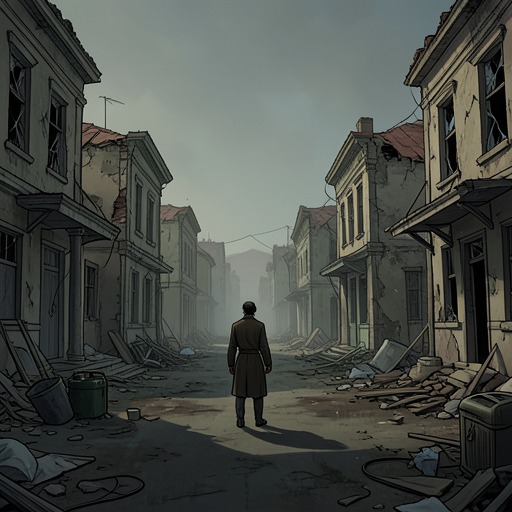
Jerusalem’s Lot’s vampiric occupation is therefore both a supernatural takeover and a crisis of recognition. The town is dead before its residents, neighbors, or passing motorists can name it dead. Its routines continue, its buildings remain standing, and its lights still shine, but the social meaning of those signs has changed. Work, family, commerce, burial, and domestic protection persist as empty forms while vampirism supplies the underlying order. The state also gives physical shape to the novel’s recurring contrast between daylight normality and nocturnal evil. Sunshine places the vampires into sleep, while darkness releases them to feed and convert. The seasonal movement toward Halloween and winter intensifies the sense that the town has entered a longer night. Against that rhythm, the instinctive search for crosses and religious symbols suggests that resistance begins not with complete knowledge but with an imperfect act of faith. What makes the occupation especially devastating is its compatibility with ordinary social blindness. Gossip can circulate without producing truth; economic systems can promise security while imposing dependency; public rituals can acknowledge death without recognizing its cause; and a town can display every appearance of life while being hollowed out from within. Jerusalem’s Lot is not simply conquered from outside. Its existing habits of denial, privacy, hierarchy, and routine allow the vampires to turn the town’s own structures into instruments of occupation.